 |
 |
 |
 |
 |
 |
|
 |
 |
 |
 |
 |
||
Concrete Roof Tile
Concrete roof tile is made of sand, cement, and water. The exact materials vary somewhat with each manufacturer but basically contain Portland cement, blended hydraulic cements and fly ash, sand, and other aggregates. The products from most manufacturers look very similar in size and shapes and colors. There are several manufacturers of concrete tile. See our web page Roofing Guidelines Examples for some information about the proper installation of Clay and Concrete Tile roofing materials.
Concrete roof tile has three main appearances based on their profiles:
- Flat Profile concrete roof tile is flat - no curves when viewed from its butt.
- Low Profile concrete roofing tile has small curves when viewed from its butt that have a rise to width ratio equal to 1:5 or less.
- High Profile concrete tile has larger curves when viewed from its butt that have a rise to width ratio greater than 1:5.
Concrete tile is available in several different colors and a couple of textures. The surface texture of the tile can be smooth or rough. Most are color impregnated rather than just slurry coated.
Concrete tile is available in standard weight and lightweight tile. It is advisable to stay away from lightweight tile if you can. They are much weaker and hard to walk on without breaking some and are very susceptible to breakage from hail and heavy snow loads compared to standard weight Concrete tile. Lightweight tile costs more than standard weight. In my opinion it would be better money spent to use the extra money it would cost for lightweight tile for consultation fees of a structural engineer and use the standard weight tile.
When specifying Concrete Tile make sure to state the Manufacturer, name of the tile, Color, and Type.
The life expectancy for a concrete tile roof is marketed as a 50 year roof. However, the underlayment and batten system, even if good material and the proper installation procedure was used, will not last that long and will have to be replaced generally around 30 to 40 years. Many tile roof underlayments and battens must be replaced much sooner because of the inferior materials and installation procedures used - sometimes within the first five to eight years. The concrete tile also loses color and some surface texture after several years.
Tile roofs are prone to moisture penetration from wind driven rain or snow more than any other type of roofing product. That is why the underlayment, batten system, and flashing and how they are installed is so very important and is the key to how long a tile roof lasts. Most Concrete Tile roofs are only single ply roof systems where Asphalt Shingles are 2 plies, and Wood Shakes and Shingles are 2 and 3 plies. Almost everything gets in under a tile roof from rain and snow to leaves, dirt, and even small birds, animals and their nests and of course insects like wasps and bees. I found a snakeskin once that had been shed. However, a concrete tile roof can be a very good roof, but only if it and the underlayments, battens, and flashings are installed correctly.
Concrete Tile
- If properly installed with the appropriate materials, is more expensive compared to most Asphalt Shingles, less than most Clay Tile, and in the range of a properly installed Cedar Shake or Shingle roof.
- is one of the most difficult roofing materials to install correctly.
- is very slow and difficult to cut valleys and around roof protrusions. Must use a special saw.
- requires a good deal of craftsmanship to install correctly. A beginning roofer can be taught to install a Concrete Tile roof properly with supervision in about six months or so.
- is a single ply roofing system, meaning that when drilling a hole anywhere through the exposed surface area of the tile the drill would reach the underlayment without going through any additional layers of tile.
- easily allows moisture penetration through the tile butts and sides to the underlayment.
- cannot be easily walked on without damaging the roof. However, when there is a properly installed batten system and standard weight Concrete tile, breaking tile is limited if proper walking techniques are used.
- is fairly easy to repair if a tile is broken. Finding a leak can be a nightmare especially if the horizontal battens are installed directly to the deck. (This method, while used in many places, is not the proper installation if the roof is in an area that receives wind driven snow and for that matter rain.)
- should last 30 to 40 years depending on the proper installation of the underlayment, battens and flashing.
- is usually installed as a Class A Fire Rated roof system.
- is more resistant to damage from hail than many other types of Steep-Roofing materials.
- is resistant to wind blow off if properly nailed with one nail in every lugged tile and two nails in every non-lugged tile.
- is very difficult to install on small areas and on difficult cut up architectural areas.
- allows snow to slide off the roof easier than most other roofing materials, especially with smooth tile.
- is heavy in weight, from about 7.5 pounds per square foot for lightweight tile to just over 10 or 11 pounds per square foot for standard weight tile.
- starts fading within the first year. If replacement tile is needed, it will take years for it to blend in.
- is very difficult to match colors when from different runs. A replaced area of tile will never quite look the same as the rest of the roof.
- colors and shades come and go all the time. The manufacturers change colors fairly frequently except for a few standards they might have.
- can be installed in all temperatures from near 0 to 120 degrees or more.
- is very slippery when wet. Is very dangerous to walk on when wet.

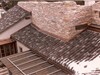
Photo of a staggard Shake type/style Concrete Tile Roof
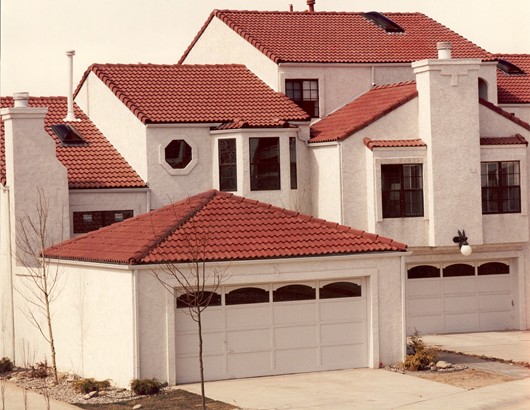
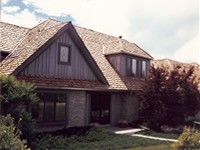
Photo of a S type/style Concrete Tile Roof
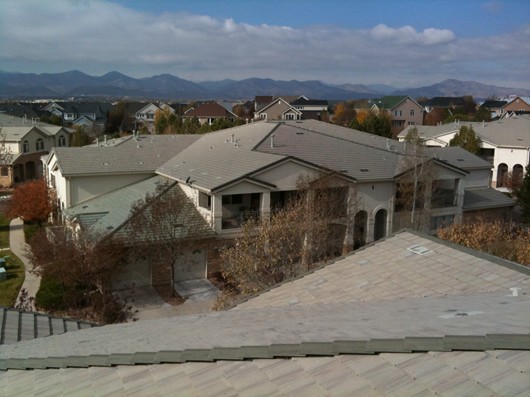
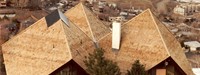
Photo of a Slate type/style Concrete Tile Roof
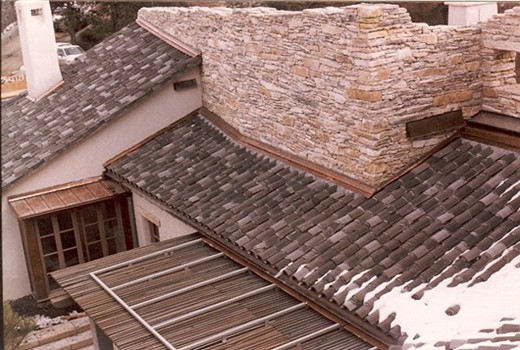
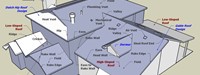
Photo of a another kind of Tile Roofing Material, a Pan and Cover type/style Clay Tile Roof
Visit our
Roof Inspection Services
web page
and the many other web
pages throughout this website to find
answers to your roofing questions and
solutions to your roofing problems.
Page Revised/Updated 2/27/2023